• Study Magic with Me
  • Home
  • Blog
  • Books
    • BOOK: Your Faery Magic
    • BOOK: Gods and Goddesses of Wales
    • BOOK: All That Glitters
    • BOOK: TWISTED
    • BOOK: Folktales, Faeries, and Spirits
    • BOOK: Crimson Craft – sexual magic for the solo witch
    • BOOK: Storytelling for Magic
    • Resources for My Readers
  • Storytelling
  • Music
  • Poetry
  • Press
  • Podcast

Halo Quin

~ Author, storyteller, singer-songwriter, witch

Category Archives: Philosophy

Becoming a Druid – Druid Camp 2025

25 Monday Aug 2025

Posted by Haloquin in Druidry, Events, Following Delight, Philosophy

≈ 1 Comment

Tags

Bard, Druid Camp, Druidry, Identity, Journey, Pagan, Witch

It’s been a long time since I first found myself at Druid Camp, while I haven’t made it to every camp since then it has become an important part of my calendar. This year it felt like more than a fun event, it felt like a homecoming, like finding paganism and witchcraft did all those years ago.

Which is ironic since we were on new land and the theme was “Re-birth”!

A campfire at night

Since the very wet Pembrokeshire-based camp in 2023 where we connected with Ceridwen and Taliesin (yay!) and I taught a pair of workshops working with them, the voice, inspiration, Awen… the old team led by powerhouse Mark Graham passed the baton to the wonderfully tenacious Esther (“Esther from Leicester” as she introduces herself) and a crew of talented, dedicated people. But Druid Camp had also moved away from the old Rainbow Spirit site in Gloucester and the Pembrokeshire site didn’t quite fit, so we needed a new home.

And Bear and Minx opened the doors of Dragonwood.

Over the past 18 months members of the camp community rallied and worked with the land, and this August Druid Camp settled into land that welcomed us like old friends.

Glorious sunshine, curious spirits, and whispering willows embraced us as Druid Camp was reborn.

I’m still integrating the gentle but powerful shifts I felt while there, and perhaps there won’t ever be words to tell you of the gifts I have received, and saw others touched by too, but I can tell you some things:

The team did an amazing job.

The land is used to magical folk and wants to speak with us.

And for the first time in 10 years I really felt like a part of this community, not hanging out on the edge but right in the heart of it.
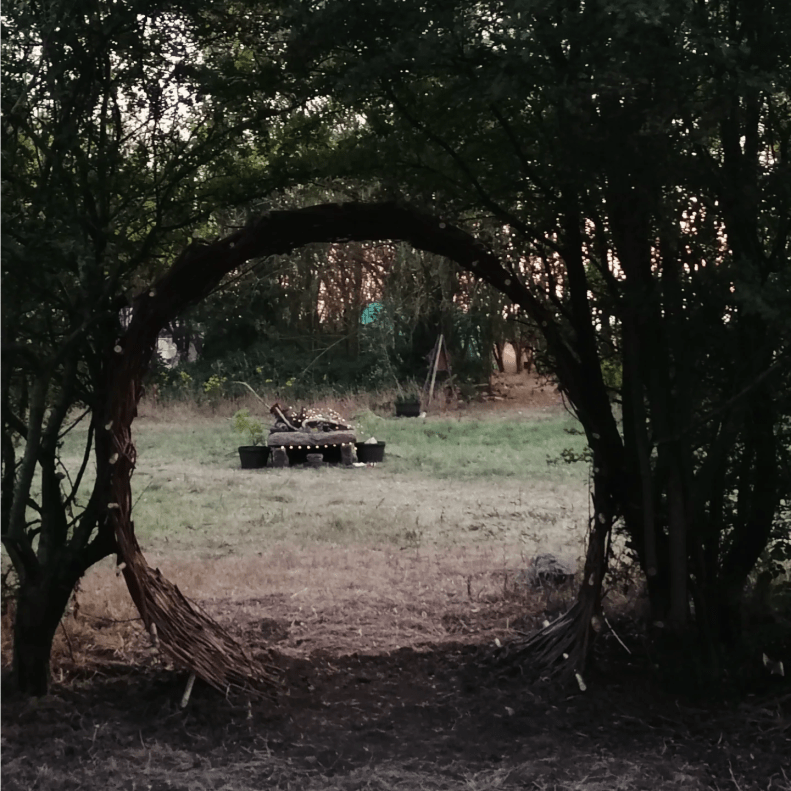
A circular doorway of willow between two hawthorn trees, framing a stone altar.

This is not a criticism of previous camps, but a reflection of my journey!

I wrote about my second year here – “A Faery at Druid Camp” – and my wariness of “druids” in general in “The Trouble with Druids“. 2023 marked a definite shift for me and I shared my experience of “Being Bardic at Druid Camp” where I was feeling more at home, more recognised, and more like I belonged, but this year I was no longer asking the question “does this make me a druid?” but stating something that has become true:

“I am a druid.”

Now, I joined OBOD a few years ago and have worked my way through the grades of Bard and Ovate. As of writing this I’m halfway through the Druid Grade material, so I can claim the title on that technicality, but now, after the “Initiation into the Spirit of Camp” ritual held by the new lead ritualist of camp Jay “Beekeeper” Anderson, now I feel it. And yes…

I had studied storytelling and performance as enchantment as a Bard – and still do.

I had practiced the magic of the deep green land as an Ovate – and still do!

And I regularly lead rituals and teach (and spent 20+ years studying philosophy academically, a traditional druid past-time!)

But becoming a Druid, for me, isn’t just about knowing stuff. It’s about finding a home in a community where you can share those skills and where the land recognises you as well as the people.

Halo smiling at the camera with three golden dots of clay on their forehead and tents in the background.

I’ll always be a witch,

and I’m certainly a magician,

but now I know –

I’m a druid too.

I’m always fascinated by what people mean when they say that they’re a druid, a witch, a magician, a pagan, and so on. Sometimes the journey is quick – you find a term and it just fits. And sometimes the journey is long, and starts with a bad impression but you find yourself returning again and again.

I’d love to hear from you, please do comment below – what is your favourite word to describe yourself and the path you’re on, and how did you come to it?


Speaking of community…

The Enchanted Academy Community

Or T.E.A. for short, because tea is magic. Doors open for the free community now, join today for:

  • Magical community
  • Oracle & healing swaps
  • Magical Masterclasses & events
Join TEA here FREE!

An academy and forum for learning magic. Sign up to my mailing list to hear about upcoming courses and get my monthly news and musings.

A wide shot of Halo on a dimly lit stage at Druid Camp, in a gold shirt, with audience sat on camping chairs - singing Cryptozoologist.
Singing Cryptozoologist – you are all fabulous time keepers!

PS: Cryptozoologist lyrics here – for those that want them! New verses will be added soon!

To Re-enchant the (already Enchanted) World

11 Tuesday Feb 2025

Posted by Haloquin in Druidry, Enchanted, Magic, Philosophy, Reflections

≈ Leave a comment

Tags

Bard, Bardic Magic, Bardic Skills, Become a Bard, Ceridwen, Cerridwen, Druidry, learn magic, Magic, musings, Pagan, Pagan Author, paganism, Strangeness of Life, Taliesin

Re-enchant the world.

If you’re already deep into magical space this might sound like a contradiction, as the world is already Enchanted.

Well, yes, your world is.

And my world is.

But for many, the world is disenchanted.

This is a phrase I use a lot, and for me it is very specifically about “world” as our Web of relationships, it isn’t about the universe, or the earth, or the realms of spirits and magicians, which are of course already and always Enchanted.

Communication always has an audience, right, so for those that feel their world is disenchanted, “reenchant the world” is for you, to encourage you to shift your relationship to the universe, the beings, your self.

It’s an invitation to re-enchant your experiences and understanding of that which is.

If “the world” is “where we live,” then many people do live in a disenchanted world, because they do not remember or accept or relate to the enchantment present beyond *their* current lived world.

“Worldview” is a way of describing it, but it also includes the “worlds” we live in culturally – my world is enchanted, but I move in worlds that are not, on occasion, because I’m interacting with other humans who do not grasp the enchanted nature of life any more, and I try to re-enchant pieces of those worlds for the others there, so they may remember their way home too.

And it’s a “re-enchantment” because Enchanted is our natural state, it is the human state, the state of all beings, and most cultures throughout history and space. The materialist culture I was raised in is the odd one, let’s be honest.

So yeah, I agree with those who critique this phrase because All is enchanted. Yes, it is indeed. And I also suggest that this is for communicating with those of you who feel you have lost that enchanted part of your world, those relationships and meanings and understandings that you live within… And this is also for those know the truth, but who see other people who have lost this knowledge that the All is Enchanted, and want to help re-enchant their world.

It’s good to re-enchant the worlds our worlds nest within.

You know, like the dominant materialist overculture that influences and shapes so much of our lives.

It’s why I use it as a catch phrase, and then, in classes and rituals and all my teaching, remind folk that the process is one of remembering, of realising that, in reality, the disenchantment is the illusion.

In the moment that is grasped, your world, like mine, is enchanted again.


Decorative banner - Cauldron of Awen, a course and bardic initiation at TEA with Halo Quin

NEW COURSE – STARTING 1ST APRIL 2025

The Cauldron of Awen is a three month adventure in storytelling, creativity, and inspiration with the witch-goddess of initiation: Ceridwen… and Taliesin, the legendary Bard of Wales.

Dive into the Cauldron’s brew and emerge inspired, with a toolkit of magical skills to enchant your audience and never fear the blank page again!

Discover More

Occult Con Reflections – Immortality

28 Thursday Nov 2024

Posted by Haloquin in Magic, Philosophy, Reflections, Storytelling

≈ 1 Comment

Tags

Diary of an Adventuress, Gilgamesh, Greek Magic, Hekate, Immortality, Magic in Wales, Memory Magic, Necromancy, occult, Occult Conference, occultism, Storytelling, witchcraft

Part of a series of posts inspired by the South Wales Occult Conference in Cardiff on 2nd November 2024 – find the first post and index here.

Starting off with the question:

“Who here is immortal?”

Was certainly a fun move for this talk by Sorita D’Este.

A dozen or so people put their hands up, including myself and the entirety of our Star Club contingent (I’m told). If I’m honest, my first thought was:

“Which part of me are you asking?”

Because actually the answer depends, but my intuitive response was completely without doubt.

Some essential part of me, the part of me that wanted to answer the question, is immortal. Don’t ask me to explain any deeper though!


The talk itself was actually exploring some of the ways in which people have historically sought immortality, and what it might mean.

From the possibility of becoming a god, reincarnation, eternal afterlives, and ghosts as astral immortality…

Through to the concept of physical immortality through meditation, or potions and preservatives…

Immortality has been a topic that has fascinated humans for a long time.

A glimpse of my conference notes

One form of immortality that feels the most possible to attain through our actions and choices is that of being remembered, and this feeds into the concept of the Mighty Dead – famous dead humans who seem to like interacting with the living, perhaps to continue being remembered! (Saints, heroes, ancient Kings and Queens…).

This is a form often mentioned in myth and legend, and one powerful curse is “may your name be forgotten”, suggesting that this is a really important piece for many of us. To be remembered is to live on in people’s hearts and minds in some way. In that famous epic Gilgamesh learned this lesson. His quest for immortality led to the realisation that he would live on through his deeds, the things he built, and as long as people spoke his name.

I know this doesn’t sound like the kind of immortality that most of us think of, its far from the eternal unchanging nature of the movie screen vampire, or the ever-living sorceress. But it is a truth that our bodies return to the Earth eventually. And even if reincarnation, or an eternal afterlife, are true, there is still something in the self-that-I-am-now that cannot survive that. The loss of this body, of this set of relationships and experiences, must be an ending of some kind. Being remembered as we are now is a way in which the self that we are lives on, as we are.

This connection between immortality and memory is so enduring, and fascinating to me.

In many pagan traditions, as in some queer spaces like the Trans Day of Remembrance events, we have begun saying the names of our dead so that they are remembered, so that they live on in our communities, and so that they are fed. It is an old practice, and a powerful one.

I do sometimes wonder, who will speak my name when I am gone? Do you know who might speak yours?

Sorita outlined several examples of people becoming gods, or gaining a cult following, or having their names immortalised. But one utterly delightful process of apotheosis (becoming divine) that she shared from inscriptions on gravestones was that which outlined how certain individuals who were aligned with specific deities of the Earth, Underworld, or Land, would be described as physically becoming that deity when their body was buried.

The buried body still has life, and feeds life, and becomes one with the living earth, the body of the goddess that they belong to. The main example given was Hekate. (If you know Sorita’s work that will be no surprise!)

So perhaps the physicists have one key to practical immortality – energy cannot be created nor destroyed, only transformed. If the Platonists were right and Hekate is the Living Soul of the Earth, then when our bodies are buried the life that they are becomes part of the life of the immortal being that is Hekate.

Our memories live on, immortal in the memories of those who come after us.

Our bodies return to the body of the Divine.

Our spirits, well, I’ve dreamed enough and journeyed enough to know that our spirits may well have adventures once this life comes to an end.

So perhaps it doesn’t matter which part of me you ask… or whether you ask the religious, the storytellers, or the physicists… I really am immortal.

But… I do really quite like it here so I’m in no rush to discover what that’s like!


Your Turn: Are you immortal? What does it mean to you? Share your story in the comments below!


Storytelling is a wonderful way to honour those that have come before and support their immortal memory… and it is an act of magic in itself. In January 2025 I have a new book coming on Storytelling for Magic – both how to use storytelling in magic and ritual, and how to learn the bardic skills for storytelling to use in other parts of your magic… And have fun!

Cover: Storytelling For Magic by Halo Quin - Bardic Skills & Ritual Craft for Witches and Pagans - text over image of a cloaked figure in warm colours, moving through wintery trees with a bird flying overhead
Order Storytelling for Magic Here*

*Affiliate link for UK folk. Also available wherever you buy your books!

Storytelling for Magic

Learn the bardic art of storytelling to craft rituals, empower your magic, and enchant your life.

In this book are the keys to bringing the gifts of the ancient magic-weavers, the storytellers, into your life. The Bards of old wove magic with their words. Through myth and legend, history and inspiration, they shaped the world around them. Just like them, you can connect with the magic of storytelling to create powerful change.

Join professional performer, ritualist, bard, and witch Halo Quin, and discover how to use your voice in magic, how to unravel the secrets of stories, how to craft your own rituals to bring the power of myths and folk tales into your life, and how to find, learn, and tell stories to enchant the world inside and outside the circle.

Out 28th January 2025

Storytelling for Magic is from Moon Books, at Collective Ink Publishing – order direct here.

The end of a chapter

19 Saturday Feb 2022

Posted by Haloquin in Creative Process, Following Delight, Magic, Philosophy, Reflections, Storytelling

≈ 1 Comment

Tags

ADHD, Adventures, Author, Bardic, Celebration, Commitment, Completion, courage, Creation, Dancing in Wales, Diary of an Adventuress, disability, elemental magic, Empowerment, Enchantment, Faery philosoper, Festivals, freedom, goblin circus, goblins, gratitude, learn magic, learn witchcraft, Living Life, Love, online course, Pagan, PhD, Philosophy, Plants, Power, Pride, process, Self Empowerment, steampunk, Stories, Storytelling, Strangeness of Life, The Enchanted Academy, Wheel of the Year, Workshop, writing

And that’s it. This month, on Imbolc eve, I finished my PhD corrections and submitted the final FINAL version. This week I got confirmation that it has been accepted!

I’m officially Dr Halo!

The thesis! Yes, I have a theme… “The power of storytelling to re-enchant the world” fits it quite nicely, don’t you think?

I celebrated with a trip to the bookshop, hot chocolate with friends, dinner for one and a movie… Then cuddles from my fella the following night, of course!

I started by letting my brain decompress and dealing with those bits of life that now need dealing with, like clearing out some old books to make space for the new ones! And contemplating where I go from here… With a foxy companion for Imbolc reminding me that spring is emerging from the dark, just like me. 🥰

If you’re on my mailing list you’ll know that I’ve got a whole bunch of monthly discussion based classes that I’m offering through Patreon, or which you can sign up for individually if you’d rather, starting with an online elements of magic workshop next month, on 16th March at 7pm GMT. (And in April I’ll be kicking off a ten week course working with them too…)

Find out more here
Uncover your inner witch - magical workshops in 2023 with Halo Quin - background image of lit candle on a beach at night.

And the Goblin Masquerade is coming together! Last autumn I was chatting with fellow changeling poet Kate Garrett, and somehow got the inspiration to host a goblin market followed by a Masked fairy ball this spring. Everything is coming together and we have music, talks, dancing, and even the steampunk debut of an Ominous Folk of Hopeless Maine show. It’s going to be a lovely day of community and play, and I’m considering it my party for escaping studenthood with a Doctorate at last!

Flier for the Goblin Masquerade in Borth, Ceredigion, Wales, 12th March, from 1pm. Free afternoon market, evening ball £6. Click for more details.

I’ve also been researching ADHD and neurodivergences… There’s so little support for adults with ADHD and we can do amazing things with the right help! So I’m writing occasional thoughts on that over here… On the newsletter “Living with Squirrels” not sure where it’ll go but you’re welcome to sign up if you like.

Living with Squirrels

So I guess I do know where I’m going next… To play with the goblins and re-enchant the world!


PS: If you want to get workshops, extra posts, advance access to material, and more things as and when the goblins inspire me… And support my adventures so I can keep building the academy into something sustainable you can sign up to my Patreon here:

Patreonise me! 😉

Faery Magic; Why Work with the Fae?

22 Friday Jan 2021

Posted by Haloquin in Faery, Magic, Philosophy, Reflections, Witchcraft 101

≈ Leave a comment

Tags

Faery, faery magic, fairies, learn witchcraft, Magic, witchcraft

We often live our lives disconnected from our bodies and from the land. The fae folk are deeply embedded in the land and the living landscape and developing a relationship with them involves coming into a good relationship with the land on which we live and with nature as a whole. Simultaneously we realise that we are part of the natural world and we come back into better relationship with our own bodies and untamed selves.

We also have records of people;

  • Looking for faeries
  • gaining healing powers from them
  • seeking treasure
  • honouring their places
  • attempting to summon Faery Queens for power, support or wish granting
  • warding against their ill-will
  • leaving offerings

Among other practices. All of this shows that the fae have power and can help us in very practical ways, or can hinder us if we do not have a good relationship with them. This is mirrored in materialistic terms when we look at how a disrespectful attitude towards nature in general has led to a great deal of pollution and ill-health, and the loss of resources… i.e. wealth! 

Basically, a good relationship with the Fair Folk is a good relationship with the spirits who share the land that looks after us, and they can support us in our magical work if we look after them in return, just as the land supports us in our general lives if we treat it with respect. This, in turn, helps to heal us, them and the world around us.

Not all of them want to work with us, even of those that are generally of friendly natures. There are numerous stories where one sibling is kind and generous and is given gifts from the faeries they meet, and another is rude to the same beings and comes away much the worse for it. And there are tales of some, like the kelpies, who steal young people away to drown them. In the New Age model fairies are generally beings of light and always willing to grant wishes in return for offerings. In the folkloric traditions some of the fae are powerful allies, but that same power means that some are worth avoiding!

Approaching these beings with respect is thus the foundation of building a mutually supportive relationship and respect gives them a good sense of who and where you are.

A good first step is to reflect on your motivations, and to ask yourself; what can I offer them?


This is an extract from my online Folkloric Faery course, including both theory and plenty of practice. and there are currently spaces on the beta testing cycle available! Come join us!

Originally posted on Patreon. Thank you to my Patrons for your support! If you like what I write then please do consider supporting me as a Patron here. Your support means I can write more for you! And you get the posts early… *tempts*

You can also tip me via ko-fi, it all helps!

You can also Follow the blog, Share this post, and find me on Twitter to join in the conversation for free!

Over to you in the comments… why would you build a relationship with spirits such as the Fae?

(Comments are moderated for spam so may take a day or two to appear.)


PS: You can also read more of my earlier thoughts on the magic of faery and how we can cultivate it in ourselves in my book Pagan Portals: Your Faery Magic published in 2015 by Moon Books.

Sign up to my mailing list here

Faery Magic; What are Faeries?

15 Friday Jan 2021

Posted by Haloquin in Faery, Magic, Philosophy, Witchcraft 101

≈ Leave a comment

Tags

Faeries, Faery, faery magic, Faery Queen, fairies, folklore, learn witchcraft, Magic, paganism, witchcraft

 TRUE THOMAS lay oer yond grassy bank,
 And he beheld a ladie gay,
 A ladie that was brisk and bold,
 Come riding oer the fernie brae.

 Her skirt was of the grass-green silk,
 Her mantel of the velvet fine,
 At ilka tett of her horse’s mane
 Hung fifty silver bells and nine. 

~ Extract from The Ballad of Thomas the Rhymer

The tale of True Thomas, or Thomas the Rhymer, is an old one from the wild borderlands of Scotland (in the North of the UK), though working with faeries and otherworldly spirits is certainly older. The earliest recorded version of Thomas’ story is recorded in a manuscript dating from around 1430-1440, and Thomas of Erceldoune, of whom the tale is written, lived two hundred years before that. The ballad which his story is most often told through nowadays was recorded in the early 1800s, and it keeps many of the key images from the earlier manuscript, demonstrating the strength of those images and their value as signposts to encounters with the fae.

“Thomas the Rhymer” is the story of how a bard gained the gift of prophecy from the Fair Folk, and it begins on the bank of a river, under a tree (most often hawthorn), where the Queen of Elfland comes across a sleeping Thomas. She takes him away, across vast rivers and past apple trees. He is taken into her service for seven years and warned to not speak a word whilst he is in Faeryland. At the end of his service to the Queen she gives him the gift of the tongue which cannot lie.

In these images we can find doorways to magical states and magical lands, guidance for developing a relationship with the fae folk and a structure through which we can build our own practices.

What are Faeries? Clues from the Queen

In all my time working with them I’ve come across a great many explanations for what they might be or how they may have come into being.

The description of the Queen in “Thomas Rhymer” as a beautiful lady in green silk, on a fine horse with bells in it’s mane gives us a few clues as to the nature of faeries. The green colour shows her role as part of the green world and the land, her horse shows her power and the bells ring with the music of faeryland. Beauty and music are signs of the way in which faery magic enchants us and conjures a sense of wonder – which encourages an openness to the world. It also reminds us that they are quite capable of showing us what we want to see in order to gain our trust. The specific location and Thomas historical status illustrate that the Fae are often connected to specific, real, places, even while they travel, and the river and the hawthorn tree are also notable as water is often a gateway to faeryland and the hawthorn is said to guard the entrance with it’s thorns, whilst the beauty of it’s blossoms open us to the sense of wonder required for travel between the worlds.

From both my experiences and the stories in which they feature I have come to the conclusion that the fae not simply one kind of being, but are a collection of related beings and powers, or spirits and energies, who embody (but are not limited to) the magic of the land and the natural world. They can be guardians of places, they are most often part of the green world or the water or stones, and they are very closely related to spirits of the dead. As spirits without bodies they are shapeshifters and so appear differently at different times, they are not limited as we are but they have a definite consciousness. They appear to me to have grown out of the earth and the land, much as we have. They make choices, have names and hold their own ethics and rules which differ from ours. 

The categories of “spirits” are impossible to define with any absolute authority, however, as the lines between spirit beings do not seem to be as clear-cut as we like to describe them. There are tales of how the fair folk were once fallen angels, or gods, and some may be becoming deities again… The spirits of the land are often considered of a different ilk, and yet they share commonalities, and our own ancestors can sometimes be found among the elves. Some traditions describe elemental spirits as faeries, and others use the term to indicate the spirits of plants. 

The common thread is that they are spirits; the magical, untamed, others who hold the magic and wisdom of the otherworld in ways which are reflected in their form. They are mutable and powerful, and, if we’re really lucky, they might just lend their power to our cause…


This is an extract from my online Folkloric Faery course, including both theory and plenty of practice. and there are currently spaces on the beta testing cycle available! Come join us!

You also can read more of my earlier thoughts on the magic of faery and how we can cultivate it in ourselves in my book Pagan Portals: Your Faery Magic published in 2015 by Moon Books.

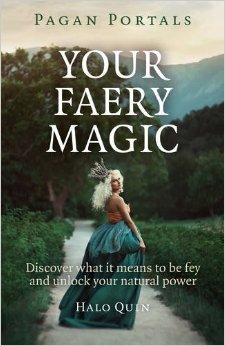
"Your Faery Magic" Book cover

Originally posted on Patreon. Thank you to my Patrons for your support! If you like what I write then please do consider supporting me as a Patron here. Your support means I can write more for you! And you get the posts early… *tempts*

You can also tip me via ko-fi, it all helps!

You can also Follow the blog, Share this post, and find me on Twitter to join in the conversation for free!

Over to you in the comments. How would you describe faeries?

(Comments are moderated for spam so may take a day or two to appear.)

Sign up to my mailing list here

Faeosophy; Faeries and Other Spirits

08 Wednesday Jun 2016

Posted by Haloquin in Enchanted, Faery, Magic, Philosophy, Reflections

≈ 1 Comment

Tags

Alfar, Faeosophy, Faery, Feyhearted path, Landwights, Magic, musings, pagan theology, paganism, Philosophy, process, Spirit work, spirits, Thealogy

Faeosophy – the philosophising of and about faeries and fae-ness.

Back in this post I shared some questions I’ve been pondering in my development of a Faerie philosophy. I began with asking who and what the Fae might be, and, based on the approach that I take to Fae-work, the Fae are spirits, our experience of them mean that they are a real part of our world (for those of us that share our world with spirits or whose world-view allows for spirits, at least) and they exist in a world populated by spirits generally. In which case;

How do the Fae relate to other spirits?

(There isn’t a straightforward answer to this, really, so what follows are some of my thoughts in exploring this!)

… “Spirits” is such a broad term, and under that label of potential spirits to work with I’m including;

  • Ancestors and beloved dead

    A dark skinned lady sat holding a honeysuckle flower, with skirts covering her legs. Clothed in greens and deep red.

    There are many kinds of spirits and none of them are clear-cut… it is more like finding families of related beings with similar energies and functions than defining them strictly.

  • Deities
  • Angels
  • Totems
  • Power Animals
  • Guides
  • Guardians
  • Genuis Locii/Spirits of a place/Landwights
  • and so on.

I also often include living beings on that list, mentally, as incarnate spirits. The Fae are generally not incarnate, not in this context anyway, so I’ll focus on discarnate beings for today!

When we start to explore these categories we find it gets even more complicated;

Ancestors; dead humans and other species, once incarnate, now not. You’d be hard pressed to find a tradition that doesn’t work with or honour the dead in some way.

Deities; a tricky one when it comes to definitions. Different traditions define deities rather differently, ranging from archetypes in our unconscious mind, through to independent beings with personalities and lives completely separate from ours. This is a whole branch of study in its own right, but for the purposes of this post I’ll broadly describe them as non-incarnate beings which hold more power than we do, normally linked to a particular kind of energy (eg. love, knowledge, painting, etc.) or a range of related energies. They generally have their own story/stories and manifest in various ways for different people.

Angels; cosmic messengers or intermediaries between ourselves and larger beings/powers. Normally within the Judeo-Christian traditions as I understand it, but not limited to them.

Guides; this describes a job rather than a type of spirit – i.e., a Guide is a spirit-being that has the role of guiding people in some way.

And so on…

The Fae seem to me to be most similar to Genius Locii or Landwights – spirits belonging to or expressing the Being/existence/essence of a particular place. They may be more or less approachable. Some of them act as guides. Some deities have Fae characteristics, such as Rhiannon, a magical woman of the otherworld who appears near a particular place (Gorsedd Narbeth). Faeries are not necessarily tied to a specific location, however, so perhaps some Fae are spirits of a particular place – those that are beings of particular lakes, trees, hills and so on – but others are not.

There are travelling Fae, that troop across wide areas, those that act as guides and those that live among us. Perhaps, though, they are simply connected to counties, countries, or families, rather than a single rock or tree.

The land of the Fae and the land of the dead

The land of the Fae and the land of the dead are often seen as the same place, and often described as reachable through water or mounds, into the earth itself.

There are also stories that conflate the Faery Realm with the realm of the Dead. The Nordic myths describe Frey as the Lord of the Alfar, and the Alfar as both Elves and Ancestors. In Irish myth Faeryland and the land of the Ancestors were both called “The Summerlands”. I take connection to mean that they are a similar energetic vibration to ancestor spirits, close enough to the material realm to overlap with our existence, hence their roles as manifestations of the non-human natural world. Perhaps the Fae are the ancestral spirits of the non-human realms, as viewed through our anthro-centric filters to allow us to relate to them?

For me this all ties in with our nature as somewhat-fey, or potentially so. We are part of nature, we are domesticated, but underneath that is the wild magic. If the Fae and our ancestors are connected, that points to be to their relation to us as part of nature.

Returning to the question at hand, however, the Fae and other spirits seem to me to be parts of a spectrum. Goddesses can be Faery Queens, Faeries can be ancestors or Genius Locii or both, and so on. Although some would, many deities would not be described as Fae, even if some would… and angels generally aren’t considered to be Fae. In some of the stories of the fall of angels, however, faeries were the angels that got left behind on earth when Heaven closed its gates and Hell became full, and those angels took up residence in the land and became Faeries. So Faeries are spirits that are intimately linked to the land and the natural world. Not all spirits that match that description are faeries, but that’s a pretty good place to start.

In short, my answer to this question is that they are a type of nature spirit, and that “spirit” covers such a wide range of beings that Faeries can fit into many categories. In terms of spirit working it will be linked very much to the land, to relating to and responding to natural currents and generally working outside of strict structures that are imposed over those currents. More often than not I define some being as Fae based on a feeling, but the pattern that has emerged for me is that that feeling often links in to the “natural” or “untamed” roots of those beings, so I try to track those connections and draw a map that makes some kind of sense!

I’d love to hear your thoughts on where Faeries sit in your understanding of spirits.

And next time I post it will be a little shorter than this!

Happy thoughts,

~ Halo x

Pwyll’s Descent – Welsh Mythology and some Faeosophy

19 Thursday May 2016

Posted by Haloquin in Enchanted, Faery, Magic, Philosophy, Stories, Storytelling

≈ Leave a comment

Tags

Annwn, Arawn, Faery, fairies, Feyhearted path, Mabinogian, Magic, musings, paganism, Philosophy, Pwyll, Rhiannon, Stories, Story

My work has risen from my experiences with spirits and magic, my theories have come from exploring the stories and putting the tales and my experiences together… So something I’m working on is weaving the theory back into context of the stories for the talks and workshops I have coming up this summer and I thought my lovely readers here would enjoy a taster!

On 5th June I’ll be co-teaching a workshop on working with the spirits of the land and this little video introduces the first part of the story and some of the ideas behind this work.

Pwyll is the “Prince of Dyfed” and, whilst out hunting, he finds himself on a strange adventure to the Welsh Otherworld, Annwn. Later he will meet Rhiannon, but first he had to prove himself worthy of honour from Annwn and its denizens… 


This story is from the first branch of The Mabinogian, a cycle of stories written down in 12th-13th Centuries and compiled together (and translated into English) by Lady Charlotte Guest. Because of the time they were written they are couched in terms of medieval society and social structures, but the magic shines through, carrying with it evidence of the oral culture and understanding of the world in which these tales were born. Tracing the patterns of the myths and stories can teach us a lot about the relationship we humans have had with the land and its spirits, and what we had learnt (and have recently mostly forgotten) about how to navigate those relationships for the benefit of both worlds.

I believe this is so important I wrote a book on how to get in touch with your own connection to the otherworlds, and you can see more about that here, and I’m constantly exploring new ways to share that understanding and the skills that worked for me with others. Bringing it back to where I began, rooted in the stories, where we learn best, feels like and important thing to do now.

I’d love to hear your thoughts!

Faeosophy; Are Faeries Real?

06 Sunday Mar 2016

Posted by Haloquin in Enchanted, Faery, Philosophy, Reflections

≈ 5 Comments

Tags

Faeosophy, Faeries, Faery, Faery philosoper, fairies, Fairy, Feyhearted path, Magic, musings, Pagan, paganism, Philosophy, Stories

Faeosophy – the philosophising of and about faeries and fae-ness.

Back in this post I shared some questions I’ve been pondering in my development of a Faerie philosophy. Of the questions listed I though these were a good place to start:

“Who and what are the Fae? How metaphorical are they? How metaphorical is our relationship to them?”

enchanted-grove-header-small.jpg

On the path of working with faeries, it’s useful to know what they are…

When working with faeries this is a kinda fundamental question on the one hand, and completely irrelevant on the other. My bottom line is that this work works for me, and it works best when I act as-if they are real. From a pragmatic perspective, then, I will continue to act as-if, and to believe that, faeries are literal, non-metaphorical beings.

One other thing – your mileage may well vary. Just because I encounter Faeries in this way does not mean that this is the only way of doing it, or that I’m right! Faeries are notoriously tricky to pin down. They are known for living in liminal spaces, for being betwixt and between, for leading us astray. They are perfectly capable of being kind and cruel, tangible and otherworldly, here and not both at once.

In which case – one answer to the question “what are the Fae?” is “paradoxical, illogical and variable.”

That’s not quite the kind of answer I was looking for though, so I’ll try again.

Little Lilith

They are the magical consciousness of nature.

In the stories they are a people with a different ethic and attitude to us. Or they are creatures intent on leading us away from human civilisation. They live in wilder places than we are used to. They can offer us help and unexpected wealth. They are uncompromising when their rules are broken. They are powerful, but subject to certain rules. They are beings of the natural world, but beings with magical powers.


In which case, they are the magical consciousness of nature.

But is this just a metaphor? Are they actual beings or are they stories we tell ourselves about the natural world but actually we don’t mean it?

When we encounter anything we have an experience, which we then understand in a certain way. We hear laughter – soundwaves are generated by someone, they enter our ears and are interpreted by our brain as laughter – just as we feel that something otherworldly is at play in the depths of the wildwood. When the laughter does not come from another human but we still hear it, echoing like bells over the waves, or when we are unsettled and certain something fae is watching us, whatever the tangible facts, we are experiencing faeries. The experience is not a metaphor, it is very real.

And, as I’ve said before, when I act as-if, when I believe that something more than what I would expect is possible, magic happens. I see or hear things that don’t make sense until I tell myself the story of faeries. They are a real something, there is a reality to them, and they make the most sense to me when I approach these experiences as faeries.

If they were just metaphors, however, they’d still be useful. If I told you a tale of dryads as a metaphor for the ways in which trees communicate through fungi and care for seedlings and stumps, and if you listened to that tale and treated trees better for it, then the metaphor would have given you a healthier way of relating to the world.

This is different to saying they have a reality independent of our stories – I and others have definitely encountered something when we’ve gone looking for faeries. When I say “I’ve seen a faery.” I don’t mean I’ve seen a flower do something I can’t explain, or that I’ve run across a natural process which I’ve needed to respect according to it’s rules. I mean I’ve had an experience, a real experience, which I understand as seeing a faerie.

Waiting for the Sun

The have a reality which is based in our personal and direct experience and so they walk alongside us, as family.

When I say “Faery”, I’m not talking metaphorically, I really mean “Faery”, because that is how I experience them. Ultimately, there is a reality here, it is my reality, and it works for me.

And perhaps that’s part of the magic of faeries; our relationship with them, our connection to them, is inherently and essentially personal and direct. We meet them, for the most part, one-to-one. They are not distant beings directing things from afar, they are walking beside us through the woods. Those that work with us are holding our hands, tripping us up, pointing out shiny things… like cousins ready for a giggle at our expense, but also, often, ready to be our family.


Some Faery Philosophy

04 Thursday Feb 2016

Posted by Haloquin in Faery, Philosophy, Reflections

≈ 1 Comment

Tags

Faery, fairies, Honesty, Imperfection, inspirations, Journey, Magic, musings, Pagan, pagan theology, paganism, Philosophy

Pandora's Box by JW Waterhouse

In my heart of hearts, I’m a philosopher, which means that I like to have thought through logically the reasons behind my beliefs. (This is sometimes like opening Pandora’s box… so here’s a disclaimer; these are my beliefs and thoughts, so I don’t expect everyone to agree with me by any means, I’m not out to convince anyone! I do find it interesting to hear why people think and say what they do though, so let’s have a discussion!)

In my last post I talk about pondering Faery Theology (there has to be a better word for this… any ideas?) so, by way of preliminary thoughts, here is an extract from chapter 3 of my book “Pagan Portals; Your Faery Magic” wherein I ponder the nature of faeries (as I see them) and the value of working with them.


If we look at the stories of Faeries, all the myths and legends, we see a common theme; they are all very strongly connected to, or embodying, nature. They are not, however, merely the plants or trees or forces they embody, they are beings that are inherently magical, beyond limits. Faeries are natural magic and, as part of nature ourselves, the magic within us is fey.

Humans are lured into Faeryland by beauty. Beautiful music, beautiful visions, beautiful food. And this beauty, once we return to earth, we pine for. So Faeryland is that place within the world, and ourselves as part of nature, in which the sense of magic, wonder and beauty lies, the natural core of our being. The heart of the world we reach through connecting to our Faery Heart.

If our hearts, at their untamed core, are places of beauty and magic, then following the call to Faeryland will open our hearts again to the beauty of the world. If we learn to touch the fey parts of ourselves then we can move through our lives open to the beauty that surrounds us and so we can reconnect to the natural world, with the other beings on the Earth as our brothers and sisters and kin.

…

And, of course, we recall the other parts of the stories of the fae…the wilder parts…the dangerous parts… They are untamed and not human and so their ethics are a little less strict than ours tend to be. In our heart we are natural beings, just like them; we have learnt really wonderful human skills, such as compassion and language, but in our search for order we have tried to tame our essential Selves and instead we have locked them away. These parts of ourselves hurt, so each day we die a little inside.

Here we choose to walk down a path that will lead us back to the parts within us that hold who we truly are. We seek all our parts, those that are good at communication, at compassion, and those that are good at standing up for us and being free. We do not have to give up the gifts of humanity in order to find our Faery Hearts and heal our lives, we can free ourselves of those things that do not serve us, release those things that hold us back and fly, carrying both gifts of humanity and gifts of Faery. We can choose to be both human and wild. That is what it means to be fey.

Fey means free. Free of the locks we’ve used to keep ourselves acceptable and free to choose to move in compassion and beauty. Fey means to be free to be our real Selves, to live our lives without unhealthy compromises, to dance to Faery music so we are filled with love and joy and deep feelings of connection even in a business meeting or on a busy, grimy underground train.

Fey means so full of shiny, happy, beauty, that you cannot help but share it.

Faeries are the conscious manifestation of the wild magic of the natural world. At our untamed core we are also part of the world, so part of our heart belongs to the realm of Faery… in which case, those of us that find our hearts singing with that wild magic? We are Fey. And when we allow ourselves to express that magic in ourselves we feel happy and we can share that happiness with the world.

It is always important in the stories to be respectful and to cultivate a good relationship with our “Good Neighbours” with whom we share a kinship, and the stories are where we first learn how to approach this people. In the same way we must learn to respect the wild world around us, to take only what we need and not deplete the land and her resources.

Growing up I was taught that the trees are conscious and aware. I was taught that the plants have feelings which deserve to be respected. I was taught that non-human animals are people just as we are. I learnt that the world around me was alive and the spirits dwell within everything. I have to eat to survive, but that doesn’t mean I don’t need to say thank you.

We are given masks to wear in our lives, but I have seen that we are much happier when we learn who we are under the masks and choose which masks to use and which to discard… and when to cast them off entirely and dance under the starlight with our friendly cousins.*

Book Cover YFM


*And it’s good to know which cousins bite, or don’t want to dance with you! You might swim in a river you know well, or cuddle your childhood canine-friend but you wouldn’t swim in a storm-tossed sea, or pick up a wild-wolf-cub with mamma wolf about to pounce, now would you? The Fae are the spirits of the wild, with all that entails.


← Older posts

(c) Halo Quin ~ author, storyteller, witch

Re-enchanting the world, one story, one song, one spell, at a time.

The Enchanted Academy - learn real magic - click here

Blog at WordPress.com.

  • Subscribe Subscribed
    • Halo Quin
    • Join 133 other subscribers
    • Already have a WordPress.com account? Log in now.
    • Halo Quin
    • Subscribe Subscribed
    • Sign up
    • Log in
    • Report this content
    • View site in Reader
    • Manage subscriptions
    • Collapse this bar
 

Loading Comments...