If you’re already deep into magical space this might sound like a contradiction, as the world is already Enchanted.
Well, yes, your world is.
And my world is.
But for many, the world is disenchanted.
This is a phrase I use a lot, and for me it is very specifically about “world” as our Web of relationships, it isn’t about the universe, or the earth, or the realms of spirits and magicians, which are of course already and always Enchanted.
Communication always has an audience, right, so for those that feel their world is disenchanted, “reenchant the world” is for you, to encourage you to shift your relationship to the universe, the beings, your self.
It’s an invitation to re-enchant your experiences and understanding of that which is.
If “the world” is “where we live,” then many people do live in a disenchanted world, because they do not remember or accept or relate to the enchantment present beyond *their* current lived world.
“Worldview” is a way of describing it, but it also includes the “worlds” we live in culturally – my world is enchanted, but I move in worlds that are not, on occasion, because I’m interacting with other humans who do not grasp the enchanted nature of life any more, and I try to re-enchant pieces of those worlds for the others there, so they may remember their way home too.
And it’s a “re-enchantment” because Enchanted is our natural state, it is the human state, the state of all beings, and most cultures throughout history and space. The materialist culture I was raised in is the odd one, let’s be honest.
So yeah, I agree with those who critique this phrase becauseAll is enchanted. Yes, it is indeed. And I also suggest that this is for communicating with those of you who feel you have lost that enchanted part of your world, those relationships and meanings and understandings that you live within… And this is also for those know the truth, but who see other people who have lost this knowledge that the All is Enchanted, and want to help re-enchant their world.
It’s good to re-enchant the worlds our worlds nest within.
You know, like the dominant materialist overculture that influences and shapes so much of our lives.
It’s why I use it as a catch phrase, and then, in classes and rituals and all my teaching, remind folk that the process is one of remembering, of realising that, in reality, the disenchantment is the illusion.
In the moment that is grasped, your world, like mine, is enchanted again.
NEW COURSE – STARTING 1ST APRIL 2025
The Cauldron of Awen is a three month adventure in storytelling, creativity, and inspiration with the witch-goddess of initiation: Ceridwen… and Taliesin, the legendary Bard of Wales.
Dive into the Cauldron’s brew and emerge inspired, with a toolkit of magical skills to enchant your audience and never fear the blank page again!
Star Club is a syncretic magical training program rooted in the Western esoteric tradition, blending ceremonial and ecstatic pagan practices to give students the opportunity to develop themselves and their skills as magicians. We teach a bit, discuss a bit, and then apply it in group ritual to get results.
Of course, once we completed the first training cycle something else emerged with a life of its own. A new modern magical order (to quote Dr Bob Plimer), complete with initiation for those that want to be a part of it… and further support and training for our members, because we never stop learning!
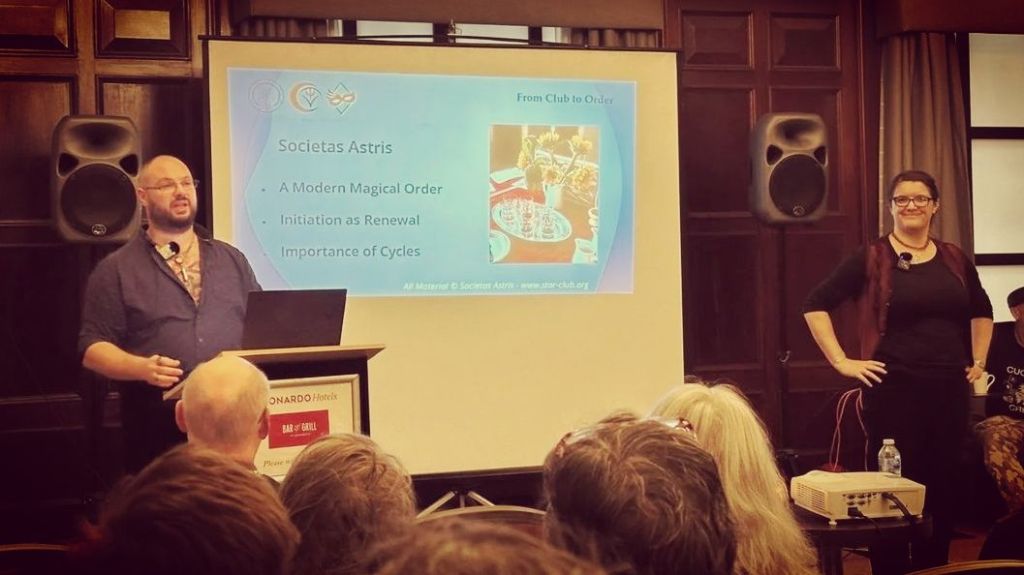
At the Conference we talked specifically about initiation and it’s impact on individuals and the order itself. How initiation occurs as part of the process of becoming…
Sef and myself, with a PowerPoint!
Initiation is a funny thing.
It can be a change initiated within you.
It can be a new chapter begun.
It can be an initiation into a tradition or order – which can be like joining a club, being adopted, or getting married.
So what happens in initiation for a modern magical order?
Initiation is by definition a beginning, but when something new begins, the old dies.
Within Star Club we designed the whole training cycle as a process which supports the transformation of self, and the initiations themselves are a part of that.
In the final session of the training cycle our final group working is our version of the ritual known as “The Headless Rite”, developed from the “Greek Magical Papyri”, which acts as an initiation of completion and integration. And then, after the cycle is complete, practitioners are invited to initiate into the order itself and we come back together for a big ritual…
The first is an initiation of internal change, the second is an initiation of becoming part of something larger than yourself.
But what is always worth remembering is that when a new person joins a group, that person is changed in relationship, and the group is also changed. It now has something that it didn’t have before.
Initiation doesn’t just change the individual… It changes the order, the magic of the club.
And as magicians, witches, pagans, and company, we know that “as above, so below” – all parts partake of each other – and thus changing ourselves, and changing the order, also changes the world.
Your Turn:
What are your stories of initiation, whether explicitly magical or spontaneously occurring, that you can share publicly? When have you stepped through a gateway, or finished a chapter, and found that it wasn’t just you that had changed but the world around you changed too?
Our mission at Star Club? To share multidisciplinary magic that gets results and changes the world.
We have in-person training cycles each year in Bristol, and if you have a group who want to learn, we can often travel to you! Or you can join our online membership to access our solo practitioner program and bonus talks and materials.
Part of a series of posts inspired by the South Wales Occult Conference in Cardiff on 2nd November 2024 – find the first post and index here.
The South Wales Occult Conference is organised and hosted by Sian Sibley and her coven, DragonOak, and when a speaker had to drop out the day before the conference Siany stepped in and gave a really interesting talk on Plants of the Underworld…
Remember: don’t eat of the Yew tree… They’re immortal but you’re not!
As a witch I often think I should be better at herbalism. When I left college I went to study holistic therapies – massage, reflexology, aromatherapy – because it seemed important to me that I should know a healing skill.
(I then spent a year trying to set up a therapy business – named Flutterby Therapies – as I figured it was the best way to offer magical healing services in a way that fit with the culture I lived in. Unfortunately I didn’t have any real business skills and it didn’t take off, but I certainly learned in the process!)
My understanding of herbalism, however, has remained rudimentary, so I was curious to hear what Siany would share about plants
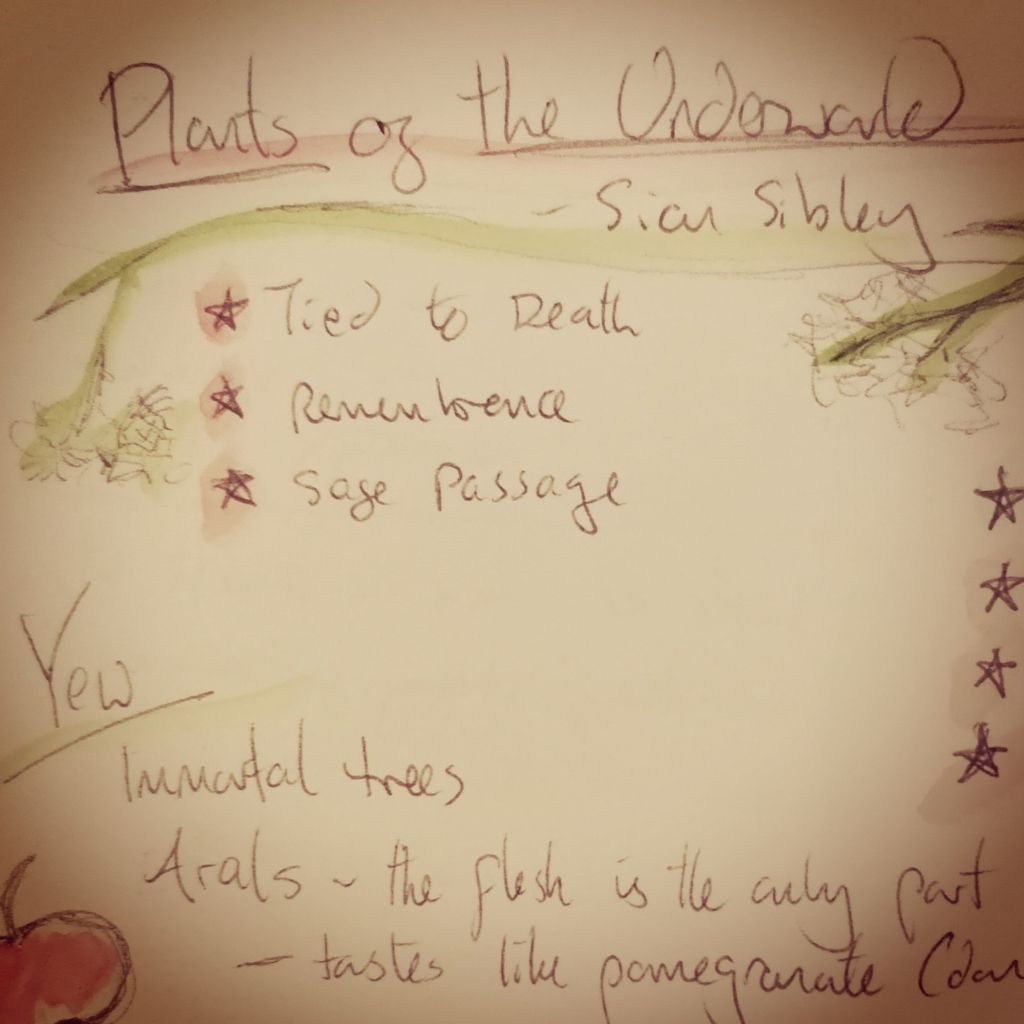
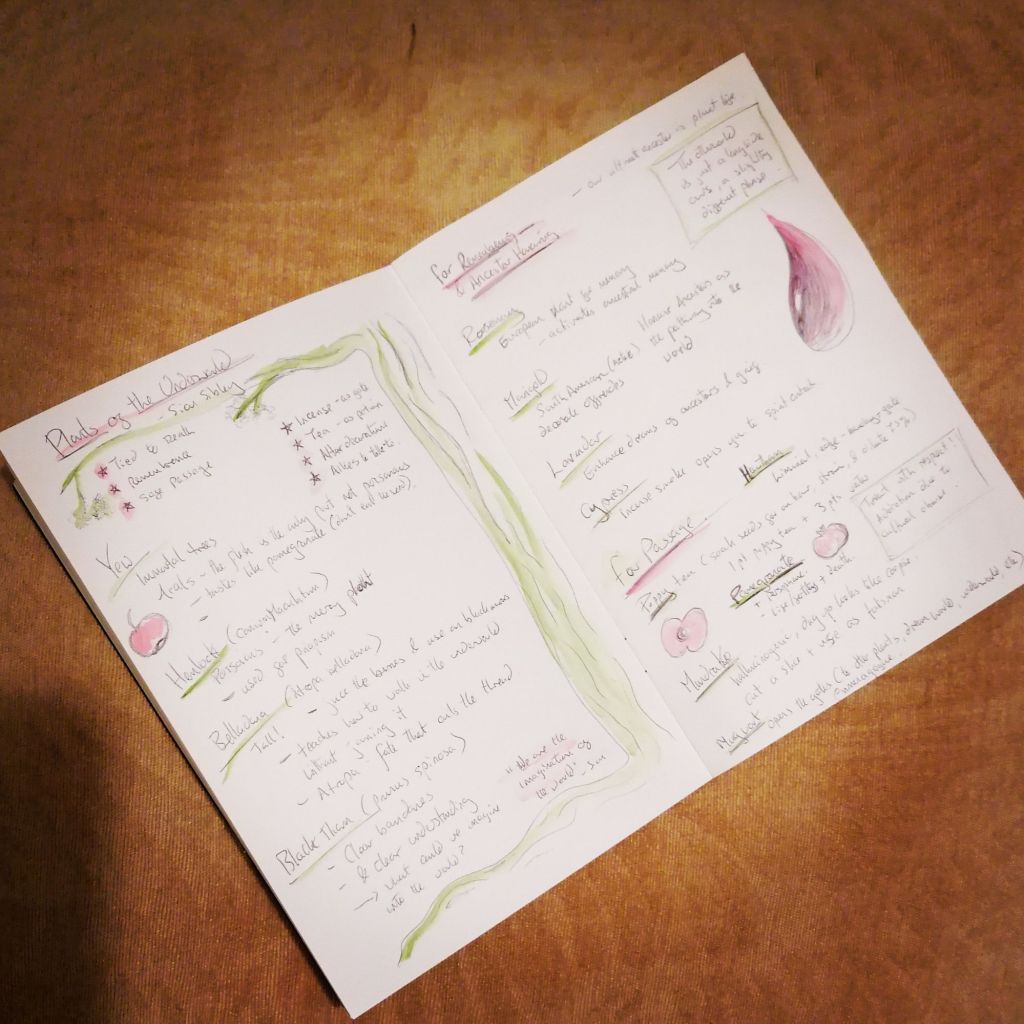
In her talk, Plants of the Underworld, Siany told us about plants that are connected to death, plants for remembering the ancestors, and plants for safe passage to (and from) the Underworld.
By doodling I keep my concentration on the talk, and it gives a visual clue to the content! I wonder what story these images make: a tree, a drop of blood, a yew aril, a pomegranate…
One thing that I really enjoyed was the reminder of how much of this I already knew, because, actually, herbalism is only one way of working with plant spirits. Some part of my spirit relaxed, finally letting go of the “should” that I’ve felt around this piece of magic which is so deeply associated with my chosen Path.
You do not need to be a herbalist to work with plants. You don’t need to get a certificate, or take a long course, or learn all the Latin names (though that can definitely be fun!). Rather, you can take a basic identification guide out and talk to the plants themselves. You can pay attention to the stories, as always, and learn from the wisdom within.
But please, if you want to practice the kind of healing involved in herbalism – consuming or applying plant material to the body – then the study is important. Our powerful plant allies can be deadly!
Identification and a basic knowledge of toxicity is particularly important for those plants associated with death and the underworld – as the easiest way to reach the Underworld is through that final gateway, from which we do not return.
Siany shared with us about the Yew tree, ancient and immortal, whose song sounds, to me, like an eternal chorus of angels, and whose presence is patient peace.
Hemlock and Belladonna, as poisonous teachers of the underworld. Blackthorn, whose scratches are so often toxic, as both guardian and guide to the liminal.
And those plants who connect us to our ancestors – Rosemary, a European plant of memory, whose chemistry stimulates remembering, and whose presence protects and reminds us of who came before.
Lavender, to enhance dreams of our ancestors and make space for grieving. So often used as an essential oil in many households it is a sedative and lowers blood pressure – which is why many people find it helps with sleep. Taking us closer to the Underworld in a gentle way.
Though be careful, still, for if you already have low blood pressure lavender can make that worse, just as rosemary raises blood pressure! Our plant allies are powerful, even the gentle ones, so a little research and a lot of getting to know them is always key.
And this makes sense, because as witches our magic is rooted in relationship, and those relationships are going to be different for each person, so it is up to you to build the relationships that work for you rather than just picking something someone has told you in a book.
Even when a plant, or deity, or other spirit, normally behaves in a particular way with most people, it doesn’t mean it will work with you that way, and vice versa of course. Relationships take time and paying attention.
One lovely piece of lore that I didn’t know was that in (some) South American cultures the Marigold is a flower for honouring the ancestors, specifically as our pathway into this world. I loved hearing about this bright, beautiful, joyful flower as part of ancestor magic. Our Underworld allies need not always be gloomy, there is beauty and joy here too.
Finally Siany shared some plants for safe passage to the underworld – Poppy, the flower of sleep and remembrance, Hawthorn, the liminal tree of edges and boundaries that feeds the travellers with berry and leaf, Pomegranates, the fruit of Persephone, of life, fertility, and death, Mandrake, with its talismanic roots shaped like our human dead, and Mugwort, the plant of opening psychic senses and brewing dreamer’s tea.
This talk wasn’t just about who to approach for what task, though, but also about the practitioner’s encounters with those plants – and for that, well, you’ll have to ask Sian Sibley herself, for those are not my stories to tell.
I love that Siany combines both a magical experience with a scientist’s background, proving that these are not only compatible approaches, but enhance each other.
Perhaps you have stories you’d like to share of when you’ve met these plants, or of things you’ve felt you “should” learn in order to be a witch, or druid, or pagan, or occultist, or whatever path you are on, and you realised that actually you don’t have to do it that way. Like me realising that I don’t need to learn herbalism, as I already have a relationship with plant spirits and there are many ways to work with them that suits me better…
Whatever they are, I’d love to hear your stories in the comments below.
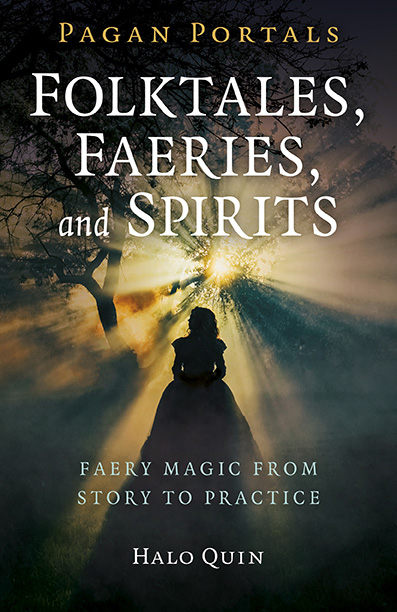
One powerful way to build relationship with the spirits of your land is through the stories and folklore local to you. Folktales, Faeries,& Spirits is a guidebook to how you can find those tales and unpick the clues within.
Folktales, Faeries, and Spirits – a practical guide to working with faeries and the spirits of nature, by Halo Quin
Growing up I always loved the idea of a coven, a space to learn and weave magic, to celebrate and heal, a space of community and immersion in enchantment.
I think the biggest thing that called me about it though was a desire for belonging.
A circle in which I could both explore magic with others, and be accepted, to come home to the sacred nature of life together.
Over time I realised I needed to feel at home in my body first, to find a sense of safety that would let me relax into the divine and tap into the witch-power within, and this fed into my crimson craft work.
But more, this is my dream for the Crimson Coven.
Offered as a training space, but, more that that, a magical circle in which you can experience the divine, your power, a space to belong in all of your parts.
(This is why I’m offering a free talk on kink and magic on 9th September in TEA – one part of ourselves that is often excluded is our desire and it’s role in any spiritual path, RSVP for Kinky Magic here.)
This is a big part of why I want to invite you into the Crimson Coven as a member, rather than focussing on stand-alone courses.
Can you imagine the deep healing and magic possible when you find a sense of belonging?
Can you dream of what it would be like to gently uncover your heart’s desire, to find safety in your body, to feel loved by the gods?
Will you gather your courage to step into a Crimson Coven and be all that you are?
The Crimson Coven Membership is now open! Within the academy schools of magic are slowly blossoming, and the first is the Crimson Coven (not to be confused with the Collective, which has now merged with the main space and remains free). You can sign up to the courses as stand-alone offerings, but I love making space for people to really explore the topics at hand.
In the Crimson Coven you’ll learn tools and concepts for your own embodied magic, and experience the energy of divine eros to help you tap into your power. You’ll work on creating deeper relationships with the deities of love and passion, and discover their support.
Included in your Crimson Coven Membership is:
a live, experiential, class every month (starting with the elements of eros series),
access to the pre-recorded course Deities of Love,
heart-centred meditations,
a growing library of pre-recorded crimson classes…
This is also where I’ll be sharing previews of my work-in-progress show Blood & Roses, and offering the Rope for Ritual and Magic classes in the New Year.
You can sign up for just £49 a month, or get discounts for a quarterly or annual membership.
Tonight I sang an hour of original songs for the Festival of the Living Rooms, an online filk festival with a lovely community which I first performed at last December. I sang about cryptids, mermaids, the lost Welsh lands, hubris, curiosity, and community.
My heart is happy.
Ten year old Halo would be so proud of us. I’m so proud of me, especially after being bullied out of singing in m teens. It’s taken me a long time to get to this point, and I’m so very grateful that I have.
The filk community have a culture of sharing music to spread the love, so for those that were there and would like to sing the songs I shared, here’s the songbook:
Each song I write is intended as both an exploration of a story, myth, or theme, and an enchantment for healing and inspiring. With many of the songs I share in these spaces, my aim is to delight, because we need more of that in the world. So, in the spirit of play, let me know about your favourite cryptids! Write a verse or share a story and I’ll weave a verse for you…
Live Babalon Circle – Visions of Babalon –Our monthly magical working to connect with Babalon – Monday 17th November, 8pm (UK) – online – replay included
Upcoming appearances include: Ancestral Pathways Conference (online, 31st Oct), Earth Sea & Sky Conference (Cardiff, 1st Nov), music at the Festival of the Living Rooms (online, Dec), Glastonbury Occult Conference (Glastonbury, 14th Feb)…
Back in February at the Glastonbury Occult Conference I gave an introductory talk on the controversial topic of Kink, Magic, and Embodiment, drawing parallels between magical and kink techniques and busting some myths about BDSM, all from a magical perspective.
I’m not going to talk about it at length here, but there’s a chapter in my book Crimson Craft – Sexual magic for the solo witch which touches on the topic of kink and magic. It’s a sensitive one for a lot of people because there are so many misunderstandings, but there is such a huge connection between the two communities and modern magical practitioners have learned a lot from the kink community’s work around consent, care, and trance techniques, among other things, while the kink community has benefitted from the space magical folk have made for the sacred and spiritual healing.
There is much to learn from each other, and we have more in common than the stereotypes would have us believe!
It is easy to look for differences, to tie our identities to what we are not rather than what we share, and we do this all the time. Witch, druid, magician, occultist, cunning one, Wiccan, Priestess… the list of options goes on.
Each of us want to understand where we belong, to find a sense of home, and we often use difference to support this.
Then one year I went to Druid Camp. Turned out that the druids there were more like me than they were different. We were all pagan, all believed in magic, all looking for connection in an earth-centered, spiritual space. It completely changed my perspective.
A year later I joined OBOD – the Order of Bards, Ovates, and Druids! (And now I’m officially part of the Druid Grade… how things change 🙂 )
I still don’t consider myself a Druid per se, but I don’t tell people they’re wrong if they call me one. In fact, I’m more likely to describe myself publicly with that umbrella term “pagan”, to highlight the similarities instead.
Because ultimately, we’re a small bunch of lovely weirdos, and we’ve got more in common than we think. When we band together our differences inspire conversation and inspiration, and we are much better able to make change in the world for the better.
So whatever label you use, or don’t, I hope you feel welcome here. There’s space for all identities (but not bigots) and when we share, like the kinksters and occultists do, everyone gets to grow.
BTW: I’m planning an online course in self-tying for magic and trance (non-sexual!) And if there’s interest I’m happy to give a version of my talk online so that any of you who are curious can come and listen!
Tell me,
my dreams,
which of you are true?
Which celestial spark points North
and leads me to my cave,
my court,
my stage?
And which is the lighthouse,
warning of the shallows
where sirens live?
Where do the rivers
of sleep lead?
In the spring of this year, I fell apart.
Some wonderful things happened. Some hard. I railed against the limitations I felt caged by. I explored ways of finding and making space.
The wheel turned, and everything changed. And nothing changed.
The trick to magical manifestation, I have always found, is to be clear on what you truly desire. When everything you’re holding together begins to fall apart, struck by lightning perhaps, you can no longer ignore the cracks. When beautiful things appear in your life they highlight the parts you’ve allowed to become stagnant.
Under the light of the stars, I find my clarity. I have stories to share, of how I became an accidental published poet, and discovered I’ve always been a Bard. I joined an Order, which makes me chuckle, and I’ve learned that I really am wired differently to the majority of people. And finally, finally, I can see a path ahead for my studies. I’ve wandered for several years without direction, buried under the weight of my thesis despite my gratitude for the opportunity. And now, perhaps, I’ve chosen a destination…
And I’ve found a way to dance again! I can no longer dance for hours every week in ATS Belly Dance, but I can strap my knees and back up (corsetry is surprisingly useful for this!), indulge in some spirits, and relax into freeform dancing as long as I listen to my body.
There is light in the darkness, always, and always more tales to tell.
My knees are burning. My back is cramping. Tears stream down my cheeks in frustration. All I want to do is dance again. To move. To feel alive.
Wall of blank.
Exhaustion rises up, fog descends.
My mantra: I am lucky. This is temporary. This too shall pass.
I don’t believe it.
My body tells me that all there is is Now. Now is all. It might be correct.
I curl up on the floor. Empty.
I catch my breath. Numb.
Noticing, with strange detachment, that the world has become distant. That I’ve been a quiet automaton for hours, days… perhaps longer.
I breathe myself back into my body. Back into my feet. Back into the burning, aching flesh.
At least I feel alive.
I notice. Even restrained, even with the limits of movement, even with the fog and frustration, Here and Now, if I can keep my self in my belly, in my feet, in my hands, in my flesh… I can breathe and expand. The deeper into the flesh I go, the deeper into the magic. The deeper into the world I sink, the more I can expand, the more I am aware of. Oh it hurts, yes, but with each breath is life. With each prickly of goosebumps the wild spirits brush my skin with fingertips, tentacles, lips dripping in nectar.
The more present I am, the more present I am with Them. The gods stand behind me, the ancestors whisper in my ear, the spirits draw near. I can feel my edges, raise my shields, let down my hair, call out the cry of a Witch in the night.
The deeper into my body I can stay, when all my instincts are to flee, to float into painless disconnection, the closer the magic is.
Her and Now. Here and Now at the crossroads of every moment. Here and Now is where the web of Wyrd is woven, where the Power lies.
I am lucky, this too shall pass, this too shall return to the Fertile Darkness from whence it came, I am lucky, there are lessons here, if I can just stop running, just be Here and Now.
Glamour is traditionally a faery magic. The ability to make something look like something else, to make something more beautiful, or ugly, is a handy skill for hiding something, or testing someone.
In many stories a magical being will appear as an ugly or low-status person, hiding their nature to test the human… asking for bread while wearing this glamour the faery asks; “Is this human worth helping? Are they honourable? Do they help others to be helpful or for their own gain? Do they respect the land and all who live here, or only wish for benefits for themselves?”
On the other hand, sometimes you’ll hear of gold that turns into dead leaves when the glamour wears off, leaving the faery laughing in the distance with the goods. Although one can’t help but wonder if perhaps the very earth from which we grow, which feeds us and houses us and receives us in the end, perhaps the earth is more valuable than gold?
On to steampunkerie! This year I’ve taken the Goblin Circus to quite a few steampunk events and I’ve been pondering glamourie again. When we dress up we’re casting a glamour on ourselves. We don’t have to use this to present an image though, instead we can use it to create a space of possibility. When we add an element of fun we open the doors of possibility further because we can relax into the magic! Steampunk is great for this! (If you like the aesthetic!) Fairy festivals can serve a similar function.
I wonder what kind of magic can flow when we use these glamours? Could we create “personas” that are simply the best version of ourselves? Our most fully realised Us? And then perform those in spaces full of fun and playfulness in such a way that they then make space for that version of ourselves to manifest in every day life? Or do we tend to relegate those playful parts of ourselves to the safe spaces of themed events? Of course, we can use it to explore our shadows, or personas completely different to our own too… in which case it probably is best to leave those glamours behind, and instead learn from them…
… and share our bread with them so they know they are honoured too.
I was thinking, at Druid Camp, that my initial impression of druids was not favourable.
I grew up a half hour bus journey from Avebury. When I was 18 I spent each of the 8 neo-pagan Festivals camping in Avebury. During the summer months I saw a particular group of Druids performing open, public rituals there. So far so good. Except that the leader would start with “Let’s do this quick so we can get to the pub!” and end it with “To the Pub!” with a fair amount of alcohol already having been imbibed.
I was not impressed that the ritual seemed to be done as an obligation, rather than as a devotional act, or an offering, or a joyful service, or a celebration, or whatever. It felt like a public show of “Look at us! Aren’t we great! Honouring the Old Ways ™!” getting in the way of drinking, rather than something that was important to the druids officiating.
It didn’t help that at this point I was teetotal.
Now, I’m certain it was important to them. I’m certain this was a bit of a joke, and I’m all for irreverent reverence. But when you are performing public ritual in a very public place then, surely, you have to expect that you are giving some people their first impression of pagans in general and druids in particular? Surely you need to take this into account?
For me, this was my first encounter with druids, and I was not impressed.
At one festival there was a second ritual, run by Bobcat and others (I only remembered Bobcat’s name because, well, bobcats!) which I really loved, but it was too late. I actually thought it was part of the same group. I’d dutifully attended all the rituals I came across whilst there in order to learn as much as I could. And because I’d assumed these were the same kind of practitioners – i.e. they’re all druids, right? So they’re all part of the same thing, right? – I didn’t really want to be involved in a group that had the opening and closing of a ritual revolving around getting wasted.
This is not to say I didn’t have good experiences with druids there. I had some lovely conversations. I also had some amusing ones where very high (as in stoned) druids attempted to educate me (conflating youth with inexperience – by then I’d been practising (neo)Witchcraft and magic for 7 years!).
Their case was also not helped, in my eyes, by the fact that I only saw them doing their public rituals in the summer. Now I suspect they performed their winter rituals somewhere sensible, or on a different day so I can’t really hold that against them!
The other issue were the moots. I got so frustrated at the few I attended with the lack of discussion about the things we shared in common – i.e. an interest in magic/paganism/druidry/stories/etc – and, when I asked someone if we were going to talk about anything, well, magical, their response was “Why would we talk about that? This is a moot!” And off they went to get drunk.
Anyway. The point of all this reminiscing is this: when we are out and about in a visible role as pagan, druid, witch, magic-worked or whatever, we are representatives, rightly or wrongly, of the group we present ourselves as belonging to. I was desperate for local pagans to connect with at that point in my life and could only find people who either patronised me or put me off!
For years I understood druids to be drunken show-offs who only paid lip-service to magic and the gods. Eventually I met some who clearly weren’t like that and slowly came to understand that that kind of group was a minority, though a VERY public minority.
This has me thinking about responsibility of visibility.
So should we make ourselves visible if we believe we are able to counteract some of the negative stereotypes and representations of our groups? Do we have a responsibility to provide an alternative to those who we feel are being unethical in their presentation? How? And, really, to what end?
I haven’t got answers, just ponderings. And a growing desire to offer workshops in ritual skills and ritual etiquette! But that might just be showing my Reclaiming Witchcraft roots…
Anyway. It isn’t really a problem with druids at all. It can be found in any group. The racist Heathens of the AFA are likely to drive good people away from Heathenry as a whole. Bitchy Witches can put people right off attending a moot or a gathering a second time. And I know of plenty of people who won’t come to Pagan Soc meetings because the society is made up of newbie pagans who haven’t found their feet yet, and they find it tiring/etc. So the questions are the same; What can we do about it? What should we do about it? Or is it just one of those things? And who am I to judge them for how they want to present themselves and their path?
Thankfully my impression of druids as a whole has changed… and I still love Avebury!